
How AI Is Changing DOOH Creative Production
The growth of digital outdoor advertising has brought incredible opportunities, but also a growing production challenge. Different screens, formats and campaign requirements mean advertisers often need more creative versions than ever before.
Bram Stevens
co-founder, youdooh
AI: Blessing or Curse for DOOH Creative Production?

Bram Stevens
co-founder, youdooh
As the number of outdoor screen networks have exploded, so too has the variety of screen dimensions, formats and specifications.
At the same time, advertisers increasingly expect campaigns to be more contextual and relevant. Time based messaging, location specific creative, weather triggers, audience segmentation and dynamic content have all moved from nice to haves to prerequisites.
Whilst advertisers benefit from more inventory and campaign activation choices than ever before, the creative implications are significant. A single campaign may require dozens of asset variations to maximise reach across different environments.
This all reinforces the perception that outdoor is only for large advertisers with professional production capacity,
Can AI help solve this challenge, alleviate pressure on stretched marketing teams and budgets and make it OOH accessible to more advertisers, or does it simply introduce new problems?
Dynamic Creative vs Generative AI
Having spent years building and managing dynamic DOOH campaigns, I've always been interested in finding ways to reduce friction in the creative production process.
When people discuss AI-generated creative, the conversation often focuses on creating entirely new designs from scratch. In reality, that's rarely the problem advertisers are trying to solve.
More often, the challenge is much simpler:
- Adapt an existing creative into multiple screen sizes.
- Create location-specific variations.
- Update messaging without rebuilding assets.
- Fill gaps when required formats are missing.
- Get campaigns live quickly without compromising quality.
- This is where the debate between traditional dynamic creative and generative AI becomes interesting.
The Case for Dynamic Creative
Dynamic creative has been powering sophisticated DOOH campaigns for years.
Built on responsive design principles, dynamic creative uses predefined rules to intelligently adapt content to different screen sizes, formats and data inputs.
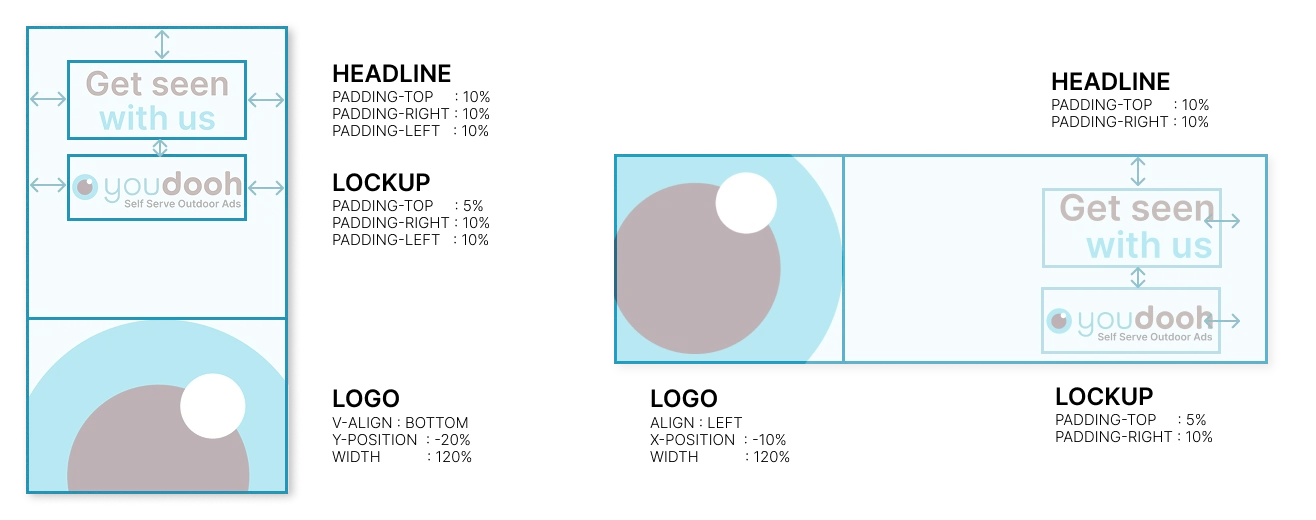
Its strengths are clear:
- Predictable and controlled outcomes
- Consistent adherence to brand guidelines
- Excellent for complex campaigns with multiple data triggers
- Highly scalable once implemented
- Ideal for enterprise advertisers and agencies with established creative workflows
For major brands with strict governance and experienced creative teams, dynamic creative remains the gold standard.
However, dynamic creative comes with trade-offs:
- Significant upfront planning and design thinking
- Development and setup costs
- Reliance on specialist tools or accredited vendors
- Less suited to campaigns requiring immediate turnaround
The Case for Generative AI
Generative AI approaches the problem differently.
Rather than following predefined rules, AI models analyse and interpret visual content before generating new pixels to fill missing areas or create variations.
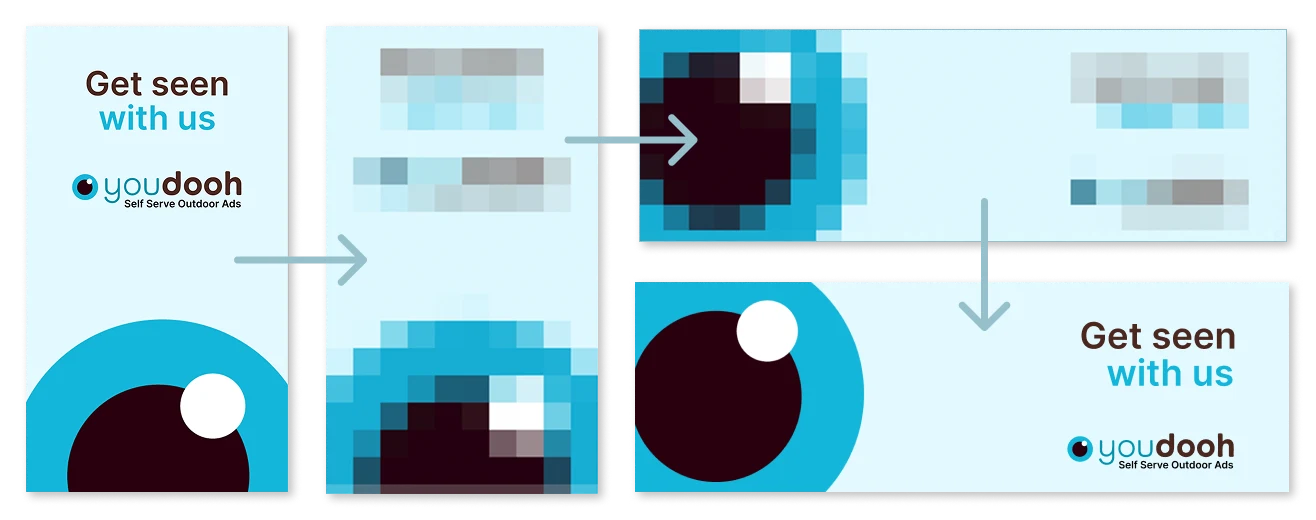
The results can be surprisingly impressive, especially in recent months.
Some of the advantages include:
- Fast turnaround times
- Minimal design expertise required
- Ability to generate missing formats from a single of multiple source assets.
- Particularly effective for image-heavy campaigns
- Accessible to smaller advertisers without agency support via youdooh
Of course, AI comes with its own limitations.
Unlike dynamic creative, outcomes are not entirely deterministic. Different models produce different results, and quality can vary significantly depending on the source asset.
There are also ongoing questions around copyright, ownership and the use of AI-generated content. While adoption continues to grow, many advertisers are still navigating the legal and governance implications.
Perhaps the biggest consideration is that AI is not a replacement for creative direction. It can generate options, but it cannot reliably replace strong design judgment.
Where AI Really Shines
In our experience, AI performs best when solving practical production problems rather than creative ones.
One of the most common examples is resizing.
Imagine you've planned a campaign and selected standard portrait and landscape inventory. Then someone suggests adding premium landmark screens.
The media opportunity is attractive, but the creative requirements suddenly become a problem. New asset dimensions are needed, timelines are tight and the production budget has already been allocated.
Historically, many advertisers would simply skip those screens.
Today, AI can often bridge that gap.
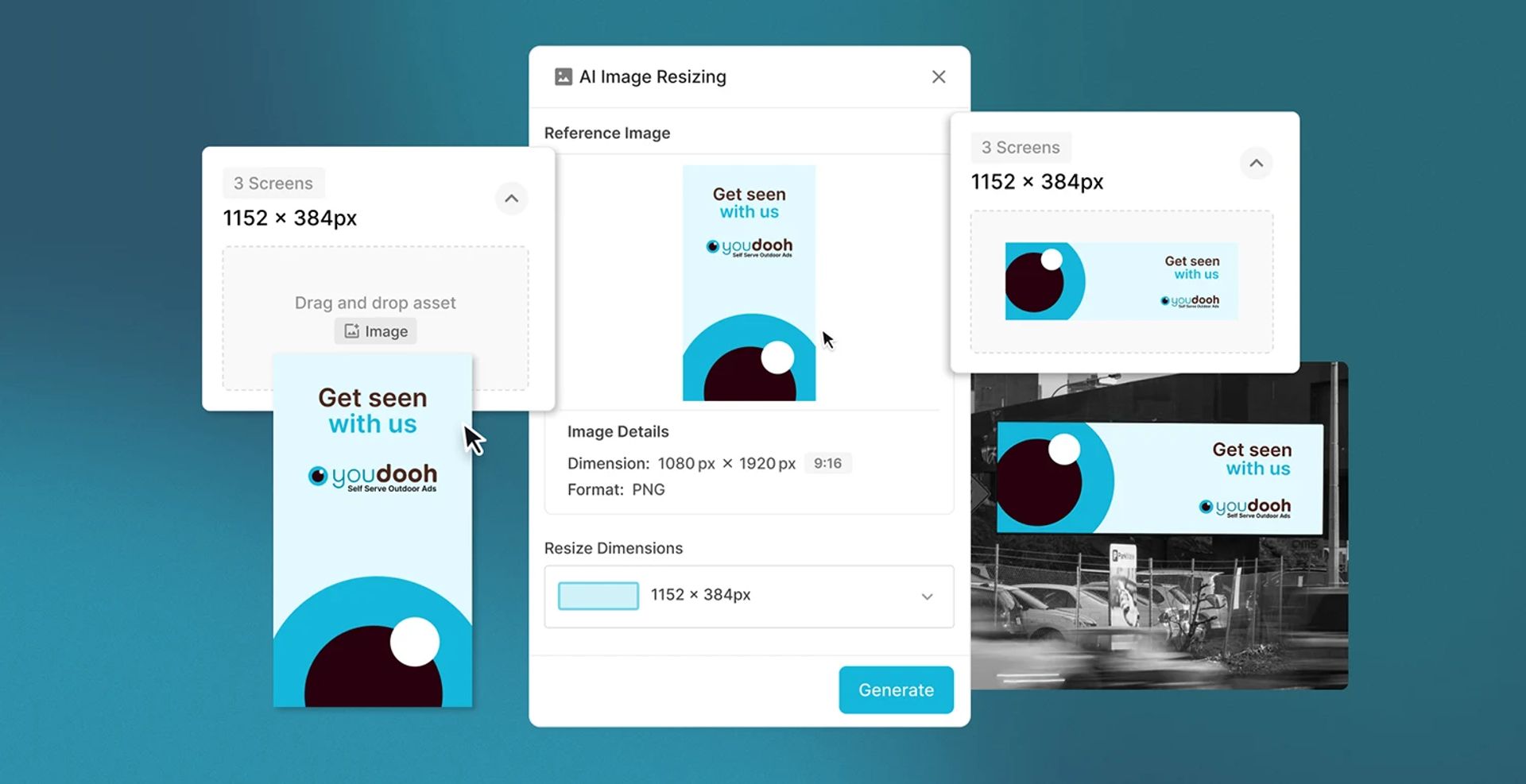
AI-Powered Creative Resizing in Youdooh
One of Youdooh's core product principles is removing friction from the buying process.
Whether you're a first time advertiser with limited resources or an experienced media buyer managing campaigns at scale, getting a campaign live should be simple.
That's why Youdooh now includes AI-powered creative resizing.
Upload a source asset, select the required format and Youdooh automatically creates the missing creative variations using AI outpainting technology.
We’ve learnt a lot in the process of building out our resizing product (more on that soon). It won't replace a designer for every campaign, but it can dramatically reduce the time and effort required to create additional asset sizes making more inventory accessible without additional production costs.
AI Blessing or Curse
So which is better, dynamic creative or AI?
The reality is that AI isn't replacing dynamic creative anytime soon.
Instead, it is filling a different role.
Dynamic creative remains the best solution when precision, brand consistency and scalability are critical.
Generative AI excels at reducing production friction, accelerating turnaround times, and helping advertisers unlock inventory that might otherwise be excluded due to creative constraints.
For DOOH advertisers, that's not a curse.
It's another tool in the toolbox.
And when used appropriately, it's a very powerful one.
Sign up for free and try out our AI resizing tool today at youdooh.com
Digital outdoor advertising made easy
Get up and running in minutes